
All companies evolve with technology.
Most have what they need to make it happen.
Few have the skills to make it pay off for customers, employees, and the bottom line at once.

Some call it innovation. Others call it transformation, or modernization. Whatever you call it, making it work takes more than cost benefit analyses and systems integrations. It takes design.
You know the version that shapes the screen. The same practice shapes the service behind it, the tools your people work in, and whether the whole thing survives a bad week or a new competitor. I've done it for twenty years, in insurance, healthcare, education, and consumer goods, and no standard title covers it.
Here’s how to write it down.
-
Every in-house role I've held got written for me. Service design didn't branch out as its own discipline until I was years into my career, and UX design followed. Both were part of my industrial design training.
Four versions of this role show up in postings. A design executive who ties design to business outcomes. An AI transformation and change leader. A strategy and operating-model builder. A service design practice leader. The titles vary: VP or Head of Design, AI Transformation, Strategy and Enablement, Service Design Practice.
-
Most decision-makers split the job across a row of chiefs. Product decides what to build. Experience fits it to people. Digital connects it to business value. Data decides what to measure. And where does Design fit? No one seems to know.
It doesn't have to be that complicated. Design is arranging things on purpose, for a purpose. And it's spent the last century arranging technology for business purposes.
It reports wherever product, operations, and technology decisions meet, because that's the only place the whole job can get done.
-
Roles where the leader is also the maker: hands-on production (Figma, shipped apps, component libraries) or engineering (model building, MLOps). I've led craft teams since before those tools existed. Design production reports up through me. Engineering doesn't, and shouldn't.
I lead the practice that arranges technology, people, and process into concepts of what a product or service could become. Then it pressure-tests those concepts against trends, risks, and stakeholder needs. The work makes the tradeoffs clear, so decision-makers can make their technology investment matter.


Stand up a new function from nothing
Operating model, capability building, design operations.
Every function I've built started with someone who'd seen the work and wanted it in-house. A leader judging my senior show offered me a job on the spot: build design research into Johnson Health Tech. Sonic Foundry asked three times over three years before I closed my agency and wrote their first senior design role with HR. American Family hired me as the first person in its new digital transformation office on the strength of an essay about design’s role in transformation that sticks and pays off past the bottom line. Then the Chief Claims Officer created a role for my skill set so I could build the same practice inside the innovation department he was standing up.
The function is real the day it stops being one person. When I joined the claims transformation below, nobody understood why design was in the room. I spent three days asking one AVP and one senior claims strategist questions, then told them how I'd organize the work, which questions came first, and what we could ignore for now. They did it. Then I heard them explaining it to the claims leaders. When I became a director, that senior strategist had first pick of who to work for. She picked me.
A department starts with an unmet need. Headcount comes later.
Make transformation pay off and stick
Business case, decision rights, customer signals into strategy.
Digital transformation is an investment with a side of disruption, so you have to squeeze out every drop of value. You're creating an operation that has to outperform the present and stand up to the future. Most decision-makers focus on the former, but the smart approach starts by defining the next products and services. Once you know what needs to improve and what needs to evolve, you can design an operation that does both: outperforms the present and stands up to the future. I call it Designed Equilibrium: a picture of the future so specific that every leader sees the same one, and a roadmap of decisions reverse-engineered to reach it.
Read how this approach produced the vision that won board approval for a claims transformation at American Family Insurance, cut annual expenses more than 20%, and absorbed triple the volume when Hurricane Ida hit.
Get every leader looking at the same picture
Executive communication, decision support, visual strategy.
A lot of my early design career was drawing installation guides for built-in refrigerators and assembly guides for grills, dishwashers, and fitness equipment. Exploded views, three-point perspective, sometimes from a rendering, sometimes from a photo of the old unit and a product manager's description of what changed. I'd draw it three or four times until he said, "Yeah, that's what it looks like." He knew how it worked and couldn't get it on the page. My job was to keep trying until what was in his head was on the page.
Moving that work from manufacturing to information technology was how I got here. Technologists have deep expertise in the technology and far less in explaining it, so I sit with them until the model in their heads is on a page anyone can follow.
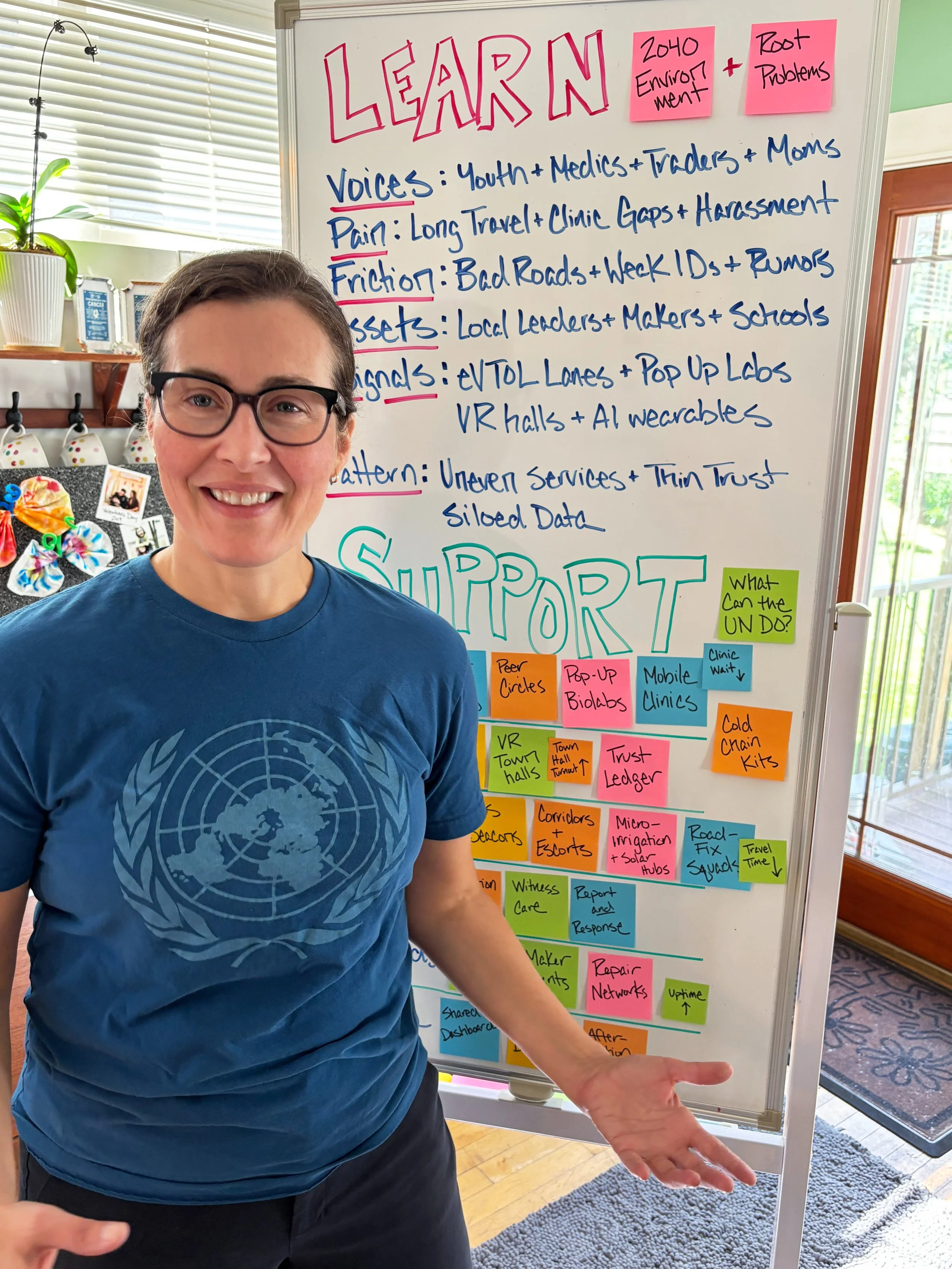
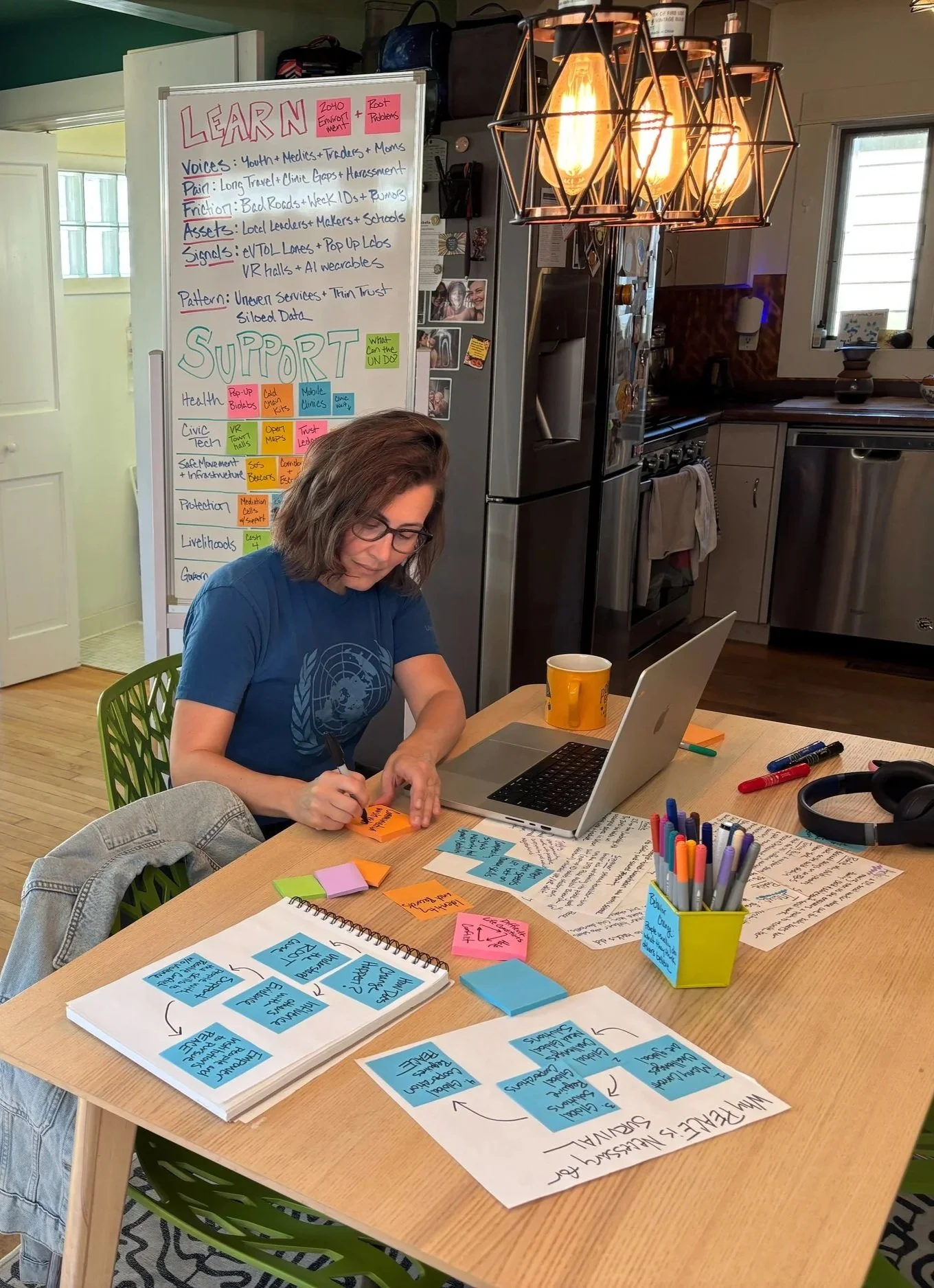
The picture looks different every time: a whiteboard of inputs and outputs, a few chosen photos beside a spoken scenario, a multimedia collection of written futures and illustrated scenes with a mental model of the platform underneath. For a new product it might be one line: think X, with the distribution of Y and the service policies of Z. Whatever it is, careful editing makes it easy to follow.
Everyone agrees the technology is hard. Most assume the communication is easy, something anyone can do on top of a demanding job. It’s that assumption that stalls decisions. Getting a room to see one picture is a skill I’ve spent a career refining.
Create value with AI
AI strategy, AI adoption and governance, human-in-the-loop.
Generative AI is a material. Like every material, leading the market with it takes innovation in two directions: new capabilities and new uses. Most decision-makers focus on advancing the capabilities while settling for a list of use cases the whole industry is already chasing. That points every advancement in the same direction and traps everyone in a never-ending efficiency contest. It's exhausting, and it all but ignores the relationship between customers and the company that serves them. Adoption suffers, and so does the return.
I design original use cases that solve real industry problems, marrying a company's unique strengths and resources with the current and projected capabilities of the technology. Then I teach the people around me to do the same, because a method that lives in one person doesn’t scale. My method creates value people can feel, designs adoption and metrics in from the first sketch, and points tech teams at the specific advances in capability that let a company serve its customers, employees, partners, and bottom line at the same time.
Read how my seven-week Design School Challenge produced a portfolio of original use cases, a co-development partnership with Deloitte Digital, and PIRfy, the concept that beat AXA, Prudential, and RBC for the 2024 Insurer Innovation Award.