
Technology changes how work gets done.
I design the change so it earns its cost and people choose to use it.
RISE's first Innovator of the Year • Reuters Trailblazing Woman in Insurance • Originated the work behind American Family's 2024 Insurer Innovation Award and its No. 71 spot on Fast Company's Best Workplaces for Innovators • UN Futuring Peace semi-finalist •
RISE's first Innovator of the Year • Reuters Trailblazing Woman in Insurance • Originated the work behind American Family's 2024 Insurer Innovation Award and its No. 71 spot on Fast Company's Best Workplaces for Innovators • UN Futuring Peace semi-finalist •
I am an award-winning transformation, AI, and innovation executive.
Some call the work innovation. Others call it transformation, or modernization. Whatever you call it, making it pay off takes design: of the operating model, the service, the tools people work in, and the decisions behind it all.
-
Companies built each of my in-house roles around this work. Today, they hire for it under four names:
AI transformation and adoption
Business transformation and modernization
Strategy, discovery, and innovation
Experience strategy and design
At the senior director to SVP level, the titles vary: Head of Business Transformation, AI Transformation Owner, Enterprise AI Adoption & Transformation, Business Discovery & Solution Strategy, Experience Strategy & Studio.
-
It sits where product, operations, data, and technology decisions meet. Design is what connects them, and that's the only place the whole job gets done. It reports to one of these leaders:
Chief Strategy Officer
Chief Transformation Officer or Head of Transformation
Chief Data Officer or Chief Technology Officer
Chief Product Officer or Chief Experience Officer
Chief Operating Officer or VP of Operations
-
What counts as hands-on has changed over the twenty years I’ve done this work in insurance, healthcare, education, and consumer goods. Today, it means:
In: prototypes built with no-code AI tools, tested with users before engineering scales them.
Out: production code, model building, and Figma production work.


Plans leaders agree on
AI transformation, multi-year roadmap, future-state, executive narratives.
Transformation stalls when leaders can’t see the same future. I design the future-state picture, the multi-year roadmap, and the executive narratives that give decision-makers a reason to move together, with the systems thinking to make it buildable. It’s how I approach AI transformation today. It’s also how my team’s four-month vision for the future of claims led American Family to become the first top-20 U.S. carrier on a single claims platform.
Teams that deliver
Facilitation, executive workshops, influence without authority, strategic partnerships.
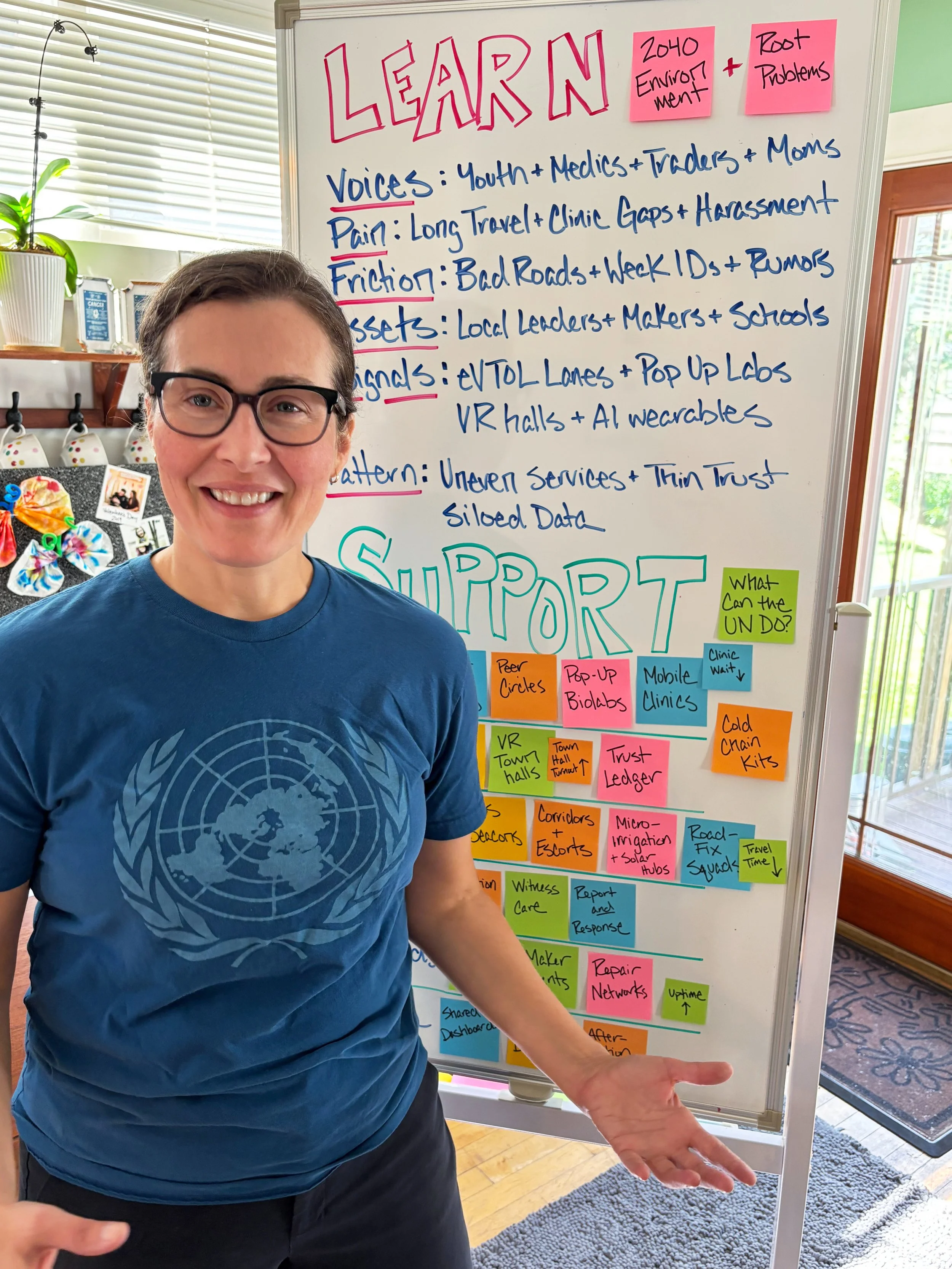
I bring people with different perspectives together around hand-picked information, and I structure the conversation so it ends with decisions they make together. That means the research, the agenda, and the translation: I get each person's expertise into a form the others can use, build a shared picture of the situation, and guide the group to the call. From inside, it feels like an unusually good meeting, the kind where everyone speaks and the group decides. It’s design people can feel, even if all they see are sticky pads and notes on a whiteboard. One participant wrote afterward that the session "connected me with my colleagues and I learned valuable things."
In 2019 I designed the sessions that let American Family's agents and corporate leaders redesign their Agency Council. I chose participants for unlike backgrounds, and the pre-work asked them the same questions about what each side needs from the other. With what's important, what's coming, and what's happening already on the table before we started, the group wrote its own mission and charter in three sessions.
In 2021 I designed and ran a five-day Auto Claims Industry Innovation Lab for thirty-five leaders from twelve companies, including Guidewire, CCC, Tractable, and Entegral. It ran backward from a sales call: customer problems first, business impact next, products last. After two sessions spent learning about different types of value and looking at claims from the customer's point of view, nine companies came back with partnership ideas built around those problems. Two became projects, including a partnership with Tractable that American Family announced the following year.
It works at any scale. A forty-five-minute session with twenty Keller Williams agents produced a year of meeting topics. After I met the CEO of a wearables company, their product leaders and my team designed a new product concept in an afternoon. A credit bureau's leaders left a ninety-minute session with nearly a hundred ideas and four directions.
Change that pays off
Value realization, change management, modernization, success measures, prioritization.
I've run two businesses of my own, so my financial sense comes from a direct line to profit and loss. I grew the first, Dilemma Studio, to five or six times its starting revenue in seven years.
The year after I built the design practice at Sonic Foundry, its Mediasite products and services grew 11%, from $12.7M to $14.1M, and lifted company revenue 4%.
Then I built a design practice inside a transformation office chartered against a nine-figure, five-year value target and funded gate by gate. Every use case needed a defensible number to reach its next gate, and a stop, pivot, or continue call at each one. I designed use cases to clear the gates from the first sketch.
When my team and I pitched a redesign of contents claims, I sized it the way a founder would: $40 billion in industry losses across 1.9 million claims a year, narrowed to what one carrier spent handling them, narrowed to what the first release could return. A portfolio manager turned the pitch into the department's benefit-sizing method.
Once the money works, I move on to development. I don't carry the numbers around, but I never skip the step where they decide. And I'd rather kill a concept on the sizing than fund it on the story.
Functions that outlast me
Operating model, capability building, ways of working, intake, make it stick.
Every function I've built started with someone who'd seen the work and wanted it in-house. A leader judging my senior show offered me a job on the spot: build design research into Johnson Health Tech. Sonic Foundry asked three times over three years before I closed my agency and wrote their first senior design role with HR. American Family hired me as the first person in its new digital transformation office on the strength of an essay about design’s role in transformation that sticks and pays off past the bottom line. Then the Chief Claims Officer created a role for my skill set so I could build the same practice inside the innovation department he was standing up.
The function is real the day it stops being one person. When I joined the claims transformation below, nobody understood why design was in the room. I spent three days asking one AVP and one senior claims strategist questions, then told them how I'd organize the work, which questions came first, and what we could ignore for now. They did it. Then I heard them explaining it to the claims leaders. When I became a director, that senior strategist had first pick of who to work for. She picked me.
A department starts with an unmet need. Headcount comes later.
AI people use
Adoption, governance, human-led, use cases, agentic.
Generative AI is a material. Like every material, leading the market with it takes innovation in two directions: new capabilities and new uses. Most decision-makers focus on advancing the capabilities while settling for a list of use cases the whole industry is already chasing. That points every advancement in the same direction and traps everyone in a never-ending efficiency contest. It's exhausting, and it all but ignores the relationship between customers and the company that serves them. Adoption suffers, and so does the return.
I design original use cases that solve real industry problems, marrying a company's unique strengths and resources with the current and projected capabilities of the technology. Then I teach the people around me to do the same, because a method that lives in one person doesn’t scale. My method creates value people can feel, designs adoption and metrics in from the first sketch, and points tech teams at the specific advances in capability that let a company serve its customers, employees, partners, and bottom line at the same time.
Read how my seven-week Design School Challenge produced a portfolio of original use cases, a co-development partnership with Deloitte Digital, and PIRfy, the concept that beat AXA, Prudential, and RBC for the 2024 Insurer Innovation Award.
Needs that unlock opportunity
Discovery, problem framing, service design, design thinking.
Design maturity that spreads
Organizational capability, culture of innovation, continuous improvement, playbooks.
Foresight that unsticks decisions
Scenarios, industry trends, emerging technologies.
Products aren't manufactured the day they're designed, and a transformation isn't finished the day it's approved. Both ship into a world that's already changed, so I look ahead first. Scenarios do two jobs in my practice. They're a design input: the futures tell you what the next product or service has to be. And they're a test: you run what you've designed, a product, an operating model, a decision, through every future and see what holds. What comes out is an idea that can be funded, killed, or put on a roadmap, and the answer to one question: what has to be true for the company to thrive in any future.
The most mature example: a collection of fourteen opportunities built to complement a three-year strategic plan, each scored on a trust-and-value metric I designed from the company's mission and handed to executives to inform roadmap and partnership decisions.
Read how my practice went from an industrial design capstone to a board-approved transformation to a United Nations semi-finalist built in twenty days, and why it travels.
Positioning that opens doors
Champion network, communities of practice, peer networks.
Get every leader looking at the same picture
Executive communication, decision support, visual strategy.
A lot of my early design career was drawing installation guides for built-in refrigerators and assembly guides for grills, dishwashers, and fitness equipment. Exploded views, three-point perspective, sometimes from a rendering, sometimes from a photo of the old unit and a product manager's description of what changed. I'd draw it three or four times until he said, "Yeah, that's what it looks like." He knew how it worked and couldn't get it on the page. My job was to keep trying until what was in his head was on the page.
Moving that work from manufacturing to information technology was how I got here. Technologists have deep expertise in the technology and far less in explaining it, so I sit with them until the model in their heads is on a page anyone can follow.
The picture looks different every time: a whiteboard of inputs and outputs, a few chosen photos beside a spoken scenario, a multimedia collection of written futures and illustrated scenes with a mental model of the platform underneath. For a new product it might be one line: think X, with the distribution of Y and the service policies of Z. Whatever it is, careful editing makes it easy to follow.
Everyone agrees the technology is hard. Most assume the communication is easy, something anyone can do on top of a demanding job. It’s that assumption that stalls decisions. Getting a room to see one picture is a skill I’ve spent a career refining.